
EQ9 Casino Australia Official Site: Deposits, Withdrawals and PayID
EQ9 Payment Methods for players in Australia in 2026. Check EQ9 Deposit Options plus the real terms behind it. Register the offer and start playing today. Updated by our editors.
- 50% first-deposit boost
- $9 daily free bonus
- AUD 50 minimum cashout

EQ9 at a glance for Aussies
Can I set a limit?
- Deposit and session limits are set in your account.
Is the site legal?
- The operator works under a licence and checks players' age.
How do I verify my account?
- You upload an ID document in your profile once.
Funding and cashing out at EQ9
| Method | Deposit | Withdrawal | |
|---|---|---|---|
| Visa | instant | 15-30 min | |
| Mastercard | instant | up to 1 hour | |
| Jeton | instant | 1-3 days | |
| Neteller | instant | instant | |
| Revolut | instant | 15-30 min | |
| Paysafecard | instant | up to 1 hour | |
| Trustly | instant | 1-3 days | |
| Skrill | instant | instant |
This 2026 guide explains how EQ9 handles payments for Australian players, from PayID, e-wallets, cards and crypto deposits to verification and cashing out. Gambling is for adults aged 18+ and carries financial risk.
How EQ9 Deposits and Withdrawals Work Step by Step
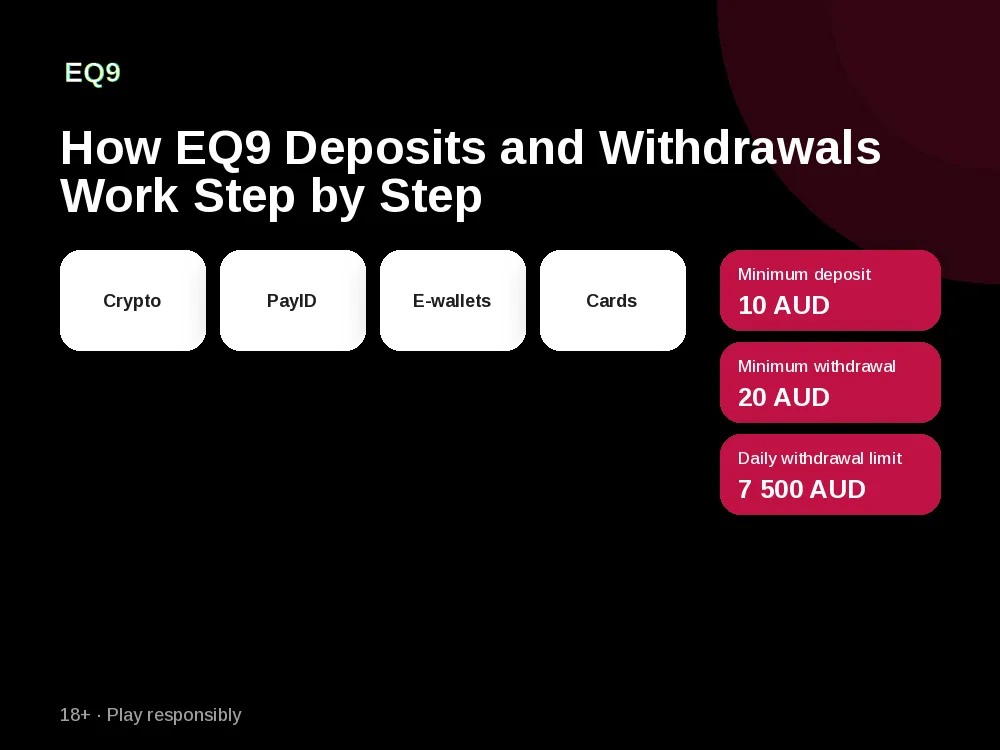
At EQ9, money moves in two separate stages: funding the account and cashing out. Each is its own decision, made through the cashier with its own method choice and checks. The steps below follow the usual order for an Australian player, from first login to withdrawal.
1. Log in to the EQ9 account, or register first if none exists.
2. Open the cashier section.
3. Choose a deposit method from the list shown there.
4. Enter the amount and confirm the deposit.
5. Play with a budget set in advance, treating the balance as entertainment money that can be lost.
6. Complete identity verification when requested, since it commonly precedes the first withdrawal.
7. Return to the cashier, select a withdrawal method and submit the request.
Fees, limits and processing times differ by method and are listed in the cashier, so they are best read before depositing. Choosing a deposit method does not automatically settle the withdrawal route, so check both sides. Setting a deposit limit before step 4 is a sensible habit.
Deposit Options for Australian Players: PayID, E-Wallets, Cards and Crypto
Deposit options at EQ9 fall into four families: PayID, e-wallets, cards and crypto. Each suits a different type of player, and none should be assumed available until the cashier lists it. The live method list is the only reliable reference for what an account can use.
Why PayID Matters for Local Deposits
PayID links a deposit to an Australian bank account through a simple identifier, such as a phone number or email, instead of long card or account details. That familiarity is why Australian players tend to look for it first. Because it runs through the player's own bank, the account holder's name should match the casino profile. Whether PayID is offered, and how it behaves for deposits, is confirmed in the EQ9 cashier rather than assumed from search results.
E-Wallets, Cards and Crypto Compared
The three remaining families differ mainly in convenience and in who controls the funds. The table compares them in qualitative terms only.
| Method family | Best suited for | What to check in the cashier |
| E-wallets | Players who prefer to keep casino spending separate from bank accounts | Whether the wallet is listed, account name matching, and withdrawal support |
| Cards | Players who want a familiar, bank-linked option | Whether deposits are accepted, and whether cards can also receive withdrawals |
| Crypto | Players already holding digital assets in their own wallet | Supported coins, network selection, and price swings between deposit and withdrawal |
Whichever family is chosen, the payment account should belong to the player, and the same route is often needed for withdrawals.
Minimum Deposits, Limits and Fees: What to Confirm Before You Pay
Minimums, limits and fees are set per payment method, so each one should be read in the EQ9 cashier before a deposit is confirmed. The only figures covered here are the 50% welcome bonus and its A$10 minimum deposit. Any other amounts belong to the cashier and the terms.
The cashier is the first place to check, since it shows what applies to the chosen method at the time of payment. The terms of use are the second, covering rules that sit behind those figures. Reading both before paying avoids surprises, and a personal deposit limit can be set before the first payment is made.
How the Welcome Deposit Interacts With Your Payment Choice
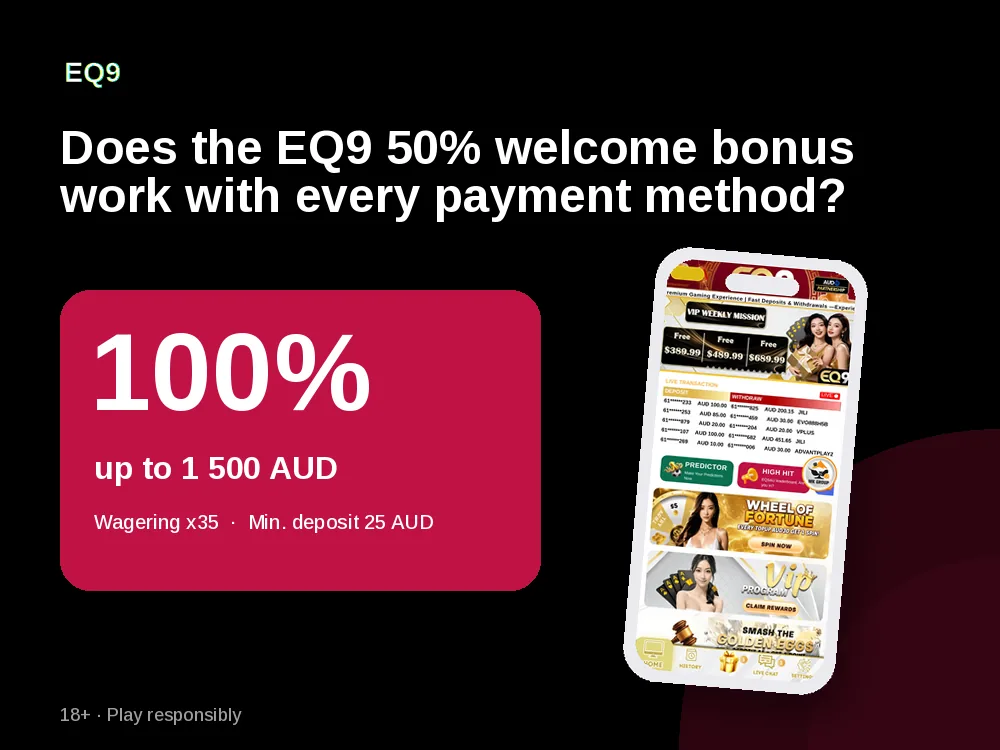
The 50% welcome bonus is a deposit offer, with a minimum deposit of A$10 listed against it. That means the bonus depends on a qualifying deposit being made, so the chosen payment method needs to accept an amount at or above that minimum. Bonus conditions, including wagering and eligible methods, are set out on the bonus page and in the terms, so they are worth reading before choosing how to pay. A bonus adds extra play money, but it does not lower the risk of losing funds.
Verification Before Your First Cashout: KYC and Payment Ownership
EQ9 requires KYC, a identity check, before withdrawals, and only players aged 18+ may register or play. Completing verification early helps avoid delays at cashout, because the request cannot be processed until the details match. Current document timing is best confirmed with the support channel.
KYC usually means confirming who the account holder is and that the payment account belongs to the same person. Submitting clear, valid documents soon after registering, rather than at the first withdrawal, tends to keep the process smoother.
SSL is the protection applied to data in transit, so personal and payment details are encrypted between the player's device and the site. Fair play relies on RNG, which keeps game outcomes random, though neither measure removes the risk of losing money.
Responsible gambling tools sit alongside verification:
- Deposit limits cap how much can be paid in over a chosen period.
- Self-exclusion blocks access to the account for a set time or permanently.
- GamCare offers independent support for anyone concerned about their gambling.
Gambling is entertainment with financial risk, not a way to earn income. Setting deposit limits before the first payment is a sensible habit.
Keeping Payments Safe: SSL, Fair Play and Account Protection
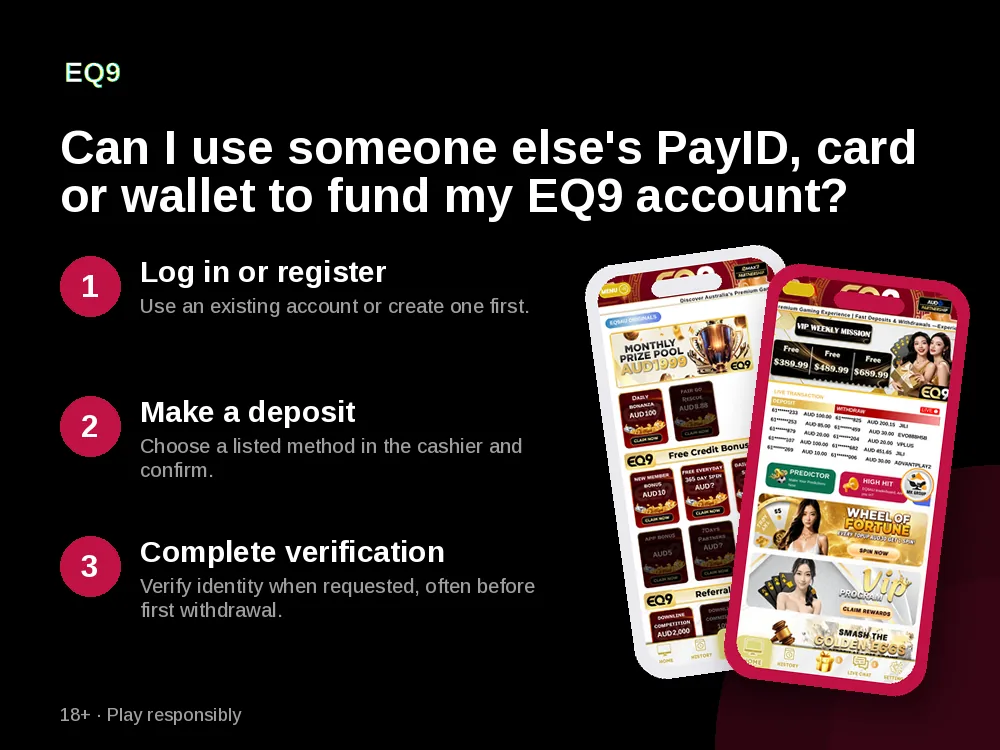
Payment safety at EQ9 rests on several layers: SSL encrypts data in transit, KYC confirms account ownership, and RNG supports random game outcomes. Convenient payment options alone do not prove a site is trustworthy, so each layer is worth understanding.
SSL protects card, bank and personal details as they travel between the device and the site. It does not protect against weak passwords or phishing, which depend on the player's own habits.
KYC adds a second layer by tying the account to a verified adult and a payment account in the same name. This helps reduce misuse and supports safer withdrawals.
RNG is the mechanism behind fair play, meaning results are generated randomly rather than set in advance. It describes how games work, not how likely a player is to win.
Practical habits strengthen these protections:
- Check that the site address is correct and begins with https before logging in.
- Use a strong, unique password and avoid reusing it elsewhere.
- Avoid public Wi-Fi when depositing or withdrawing.
- Never share login details or verification codes.
- Review account activity regularly and report anything unfamiliar to support.
Fast deposits and a wide choice of methods are conveniences, not safety guarantees.
Australian Legal and Banking Context for Online Casino Payments
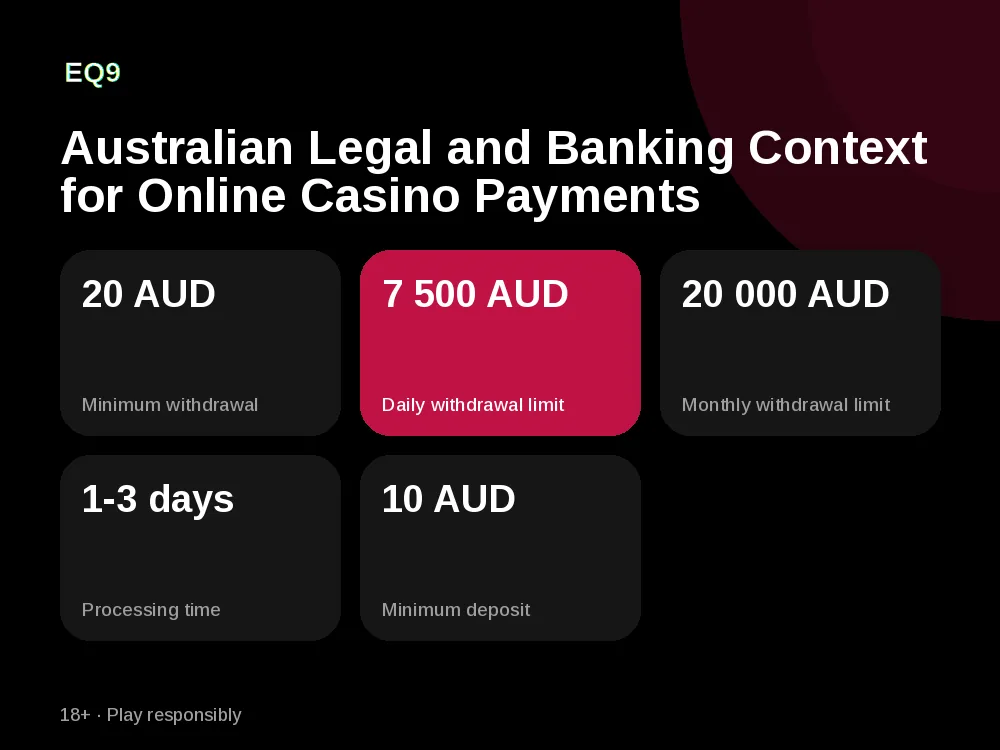
What a casino says about its payment methods and the rules that apply to Australian residents are two separate things. Brand claims describe the product, while local law and bank policies decide what is permitted and what can actually be processed. Both are worth checking separately.
Online gambling rules in Australia can change, and they may treat operators and players differently. This section is general information, not legal advice. Players who are unsure of their position should check current rules from official Australian sources before depositing.
Licensing is a separate point. The licence details for EQ9 are not repeated here, since the site footer carries the licence line and is the place to read it directly.
Banking adds its own layer:
- Banks may decline or flag gambling-related transactions under their own policies.
- Card issuers can apply their own restrictions to gambling merchants.
- Statements may show a payment processor name rather than the casino name.
If a payment fails, the bank can usually explain why.
Fixing Common Payment Problems: Declined Deposits and Delayed Withdrawals
Most payment problems at EQ9 come down to a few causes: details that do not match, incomplete verification, or a restriction on the method. Working through the checklist below in order usually finds the cause, and support can step in if it does not.
1. Check the payment details. Confirm the card number, expiry date, PayID or wallet login were entered correctly.
2. Confirm the name matches. The name on the payment account should match the name on the EQ9 account.
3. Check the cashier. Make sure the chosen method is listed for the action attempted, since a method available for deposits may differ for withdrawals.
4. Review limits and funds. Look at the method's limits in the cashier, and confirm the account has enough balance or available funds.
5. Complete KYC. A withdrawal that stays pending is often waiting on identity verification or additional documents.
6. Contact the bank or provider. Banks and wallets can block gambling transactions under their own policies.
7. Try another method. If one method keeps failing, a different method in the cashier may work, though it should belong to the player.
8. Contact support. Use live chat or email and include the account name, method, amount and transaction reference.
No response times are stated here, since current timing is best confirmed with support. Screenshots and transaction references, kept from the start, make any query easier to resolve. Avoid repeated failed attempts, which can trigger further blocks.
Before You Deposit: A Practical Checklist for Australian Players
A short set of checks before the first payment at EQ9 can prevent most avoidable problems. The list below pulls the key steps together, and each one takes only a minute to confirm. Only adults aged 18+ may play.
1. Confirm the age requirement of 18+ is met before registering.
2. Set a personal budget using money meant for entertainment, not bills or savings.
3. Activate deposit limits before the first payment.
4. Open the cashier and confirm the chosen method is listed.
5. Read the fees, limits and processing details shown for that method.
6. Check that the payment account is in the player's own name.
7. Read the bonus terms before accepting any offer.
8. Know where self-exclusion is found in case a break is needed.
9. Note that GamCare offers support if gambling stops feeling like fun.
10. Keep transaction references for every payment made.
Staying in Control of Spending: Deposit Limits, Self-Exclusion and Help
Payment habits are where gambling control starts. Used early, these tools help keep gambling within a budget and treated as entertainment, not income.
Deposit limits are the payment-side control. They cap how much can be added to the account over a chosen period, so spending stays within a figure decided in advance, not in the moment. Setting them before the first deposit is easier than after a losing run, and they work best when the amount reflects what the player can afford to lose.
Self-exclusion is for players who need a longer break. It blocks access to the account for a set time or permanently, and it is worth requesting through the account settings or support if gambling feels difficult to manage.
GamCare is an independent support resource for anyone worried about their own gambling or someone else's. Australian players can also look for local support services through official government and health websites.
Warning signs include chasing losses, depositing more than planned, or hiding gambling from others. Anyone noticing these should pause, use the tools above and seek help. Gambling carries real financial risk, and no payment method changes that.
- Bonuses4.9
- Payouts4.3
- Game selection4.3
- Mobile app4.9
- Licence & safety4.8
- Limits & terms4.9
Player questions
- What online payments does Australia use, and which of them does EQ9 list?
Australian players commonly use PayID, cards, e-wallets and crypto, and these are the four method families covered for EQ9. PayID links a deposit to a bank account through a phone number or email. Availability changes, so the live method list in the EQ9 cashier is the only reliable reference for what an account can use for deposits and withdrawals.
- What payment methods are available at EQ9 Casino for Australian players?
EQ9 payment methods fall into four families: PayID, e-wallets, cards and crypto. None should be assumed available until the cashier lists it, and a method offered for deposits may differ from one offered for withdrawals. Fees, limits and processing times are shown per method in the cashier, so reading them before paying avoids surprises.
- Where do I find the EQ9 payment methods after login?
After logging in to the EQ9 account, open the cashier section. The deposit methods are listed there, and the same area is used to select a withdrawal method and submit a request. If the account is new, register first and then return to the cashier. Fees, limits and timings for each method are displayed at the point of payment.
- Does the EQ9 50% welcome bonus work with every payment method?
Not necessarily. The 50% welcome bonus is a deposit offer with a minimum deposit of A$10, so the chosen method must accept at least that amount. Eligible methods and wagering conditions are set out on the bonus page and in the terms. A bonus adds extra play money but does not reduce the risk of losing funds.
- Why was my EQ9 deposit declined, and what should I check first?
Declines usually come from mismatched details, a method restriction or a bank block. Check that the card, PayID or wallet details are correct, the name matches the EQ9 profile, and the method is listed for that action. Banks and card issuers can flag gambling transactions under their own policies, so the bank can usually explain the reason. Avoid repeated failed attempts, which can trigger further blocks.
- Why is my EQ9 withdrawal still pending?
A pending withdrawal is often waiting on KYC, the identity check required before cashouts. The request cannot be processed until the account details and the payment account owner match. Submitting clear, valid documents soon after registering tends to keep things smoother. Current document timing is best confirmed with support, and keeping screenshots and transaction references makes any query easier to resolve.
- Is it a drawback that EQ9 requires KYC before I can cash out?
It adds a step, and that is the trade-off: some delay and paperwork in exchange for tying the account to a verified adult and a payment account in the same name. That reduces misuse and supports safer withdrawals. Completing verification early, rather than at the first withdrawal, avoids most of the friction. Only players aged 18+ may register or play.
- Can I use someone else's PayID, card or wallet to fund my EQ9 account?
No. The payment account should belong to the player, and its name should match the EQ9 profile. Using a third-party account can cause withdrawal problems because KYC checks that both belong to the same person. The same route is often needed for withdrawals, so funding from your own account keeps both sides of the cashier simple.